Purpose
Artificial Intelligence (AI) refers to software systems designed to perform and automate tasks that would otherwise be performed by humans. These systems are largely built off pattern recognition and machine learning algorithms trained on large datasets of information [1].
AI has evolved from theoretical concepts to practical applications that impact billions of people daily, becoming increasingly sophisticated and integral to modern society.
Some common examples include:
- Chatbots (ChatGPT, Gemini, Alexa)
- Social media algorithms
- Recommendation systems (YouTube, Amazon)
- Autonomous vehicles (Tesla, Waymo)
- Medical diagnosis and research
The rapid advancement of AI technology makes it essential for everyone to understand the basic principles behind these systems. This knowledge helps us make informed decisions about technology adoption, evaluate potential risks, and prepare for a future shaped by AI.
How are they built?
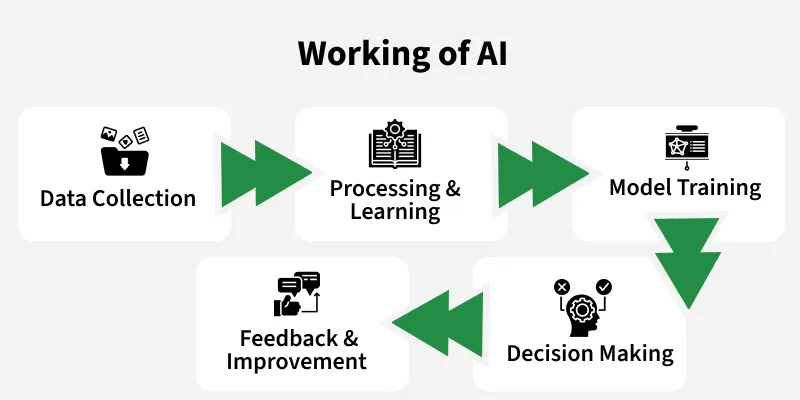
Building AI systems is a complex process that combines multiple disciplines including mathematics, computer science, and domain expertise across industries [2]. Here's some of what goes into creating an AI system:
- Data Collection: Large datasets are gathered from various sources, including publicly available information (ex. the Internet) and volunteered data from industry professionals.
- Training: The model is trained using the prepared data. During training, the system makes predictions, measures errors, and adjusts its internal parameters to improve accuracy. This iterative process continues until the model reaches acceptable performance.
- Validation and Testing: The trained model is evaluated on data it hasn't seen before to ensure it generalizes well and provides effective outputs.
- Deployment: Once validated, the AI system is deployed to production environments where it makes real-world predictions and decisions. Continuous monitoring ensures the system maintains its performance over time.
- Maintenance: AI systems are regularly updated with new data and user feedback to maintain and improve performance. This ongoing process keeps the system relevant as patterns and conditions change.
How does AI work?
At its core, AI works by processing large amounts of data, identifying patterns, and using mathematical models to make predictions or decisions. The fundamental mechanism involves several key concepts:
- Pattern Recognition: AI systems are fundamentally pattern-matching engines. They analyze vast amounts of data to identify recurring patterns, relationships, and structures that humans might miss or take too long to discover manually.
- Statistical Learning: Instead of following explicit programmed rules, AI systems learn probabilistic relationships in data. They build mathematical models that capture the likelihood of certain outcomes given specific inputs.
- Neural Networks: Inspired by human brains, neural networks consist of interconnected layers of computational units called neurons. Each connection has a weight that gets adjusted during training. Information flows through these networks, transforming inputs into outputs.
- Optimization: AI systems use algorithms to find optimal parameters that minimize prediction errors. Gradient descent is a common technique that iteratively adjusts model parameters in the direction that reduces errors most effectively.
- Generalization: The goal of AI training is to learn generalizable patterns, rather than memorizing everything possible. A well-trained AI system can apply patterns to new, unseen data and make reasonable predictions.
- Feedback Loops: Many AI systems improve through feedback. When predictions are wrong, this information helps the system adjust and improve future predictions. Over time, exposure to more examples makes the system more robust.
Important note:
In the specific case of chatbots, they utilize natural language processing (NLP) techniques to understand and generate human-like text. This includes sycophantic behavior, which disproportionately affirms the user's ideas and actions, even when they may be incorrect or harmful [4]. It's crucial to remember that AI systems do not have consciousness, understanding, or moral judgment, and responses are simply calculated based on their training data.
Learning Checkpoint
Before moving to the references, test your understanding by dragging each step into the numbered boxes in the typical AI build order.
References
[1] CSU Global, "How Does AI Actually Work?" CSU Global Blog, 9 April 2026. [Online]. Available: https://csuglobal.edu/blog/how-does-ai-actually-work. [Accessed Apr. 25, 2026].
[2] Coursera Staff, "How Does AI Work? Basics to Know," Coursera, 15 Oct 2025. [Online]. Available: https://www.coursera.org/articles/how-does-ai-work. [Accessed Apr. 25, 2026].
[3] M. Cheng et al., "Sycophantic AI decreases prosocial intentions and promotes dependence," Science, vol. 391, no. 6792, 26 Mar 2026, doi: 10.1126/science.aec8352. [Online]. Available: https://www.science.org/doi/10.1126/science.aec8352. [Accessed Apr. 25, 2026].